» HFT Trading Bot Explained: A Beginner’s Guide to High Frequency Trading Bots

High frequency trading bots are among the most advanced automated trading systems, in the financial industry. These bots execute multiple trades in milliseconds by using speed, accuracy and real time market data. Because the algorithmic trading has become more competitive, trading firms and fintech companies have made developing HFT bots as a top priority.
The definition of an HFT bot, its key features, security precautions, development process, benefits, potential revenue, and the ideal tech stack needed to build a reliable HFT trading system are all covered in this blog.
What is an HFT Bot?
An HFT bot is an automated trading system, designed to perform trades at really high speeds, often within microseconds. It analyzes market data, identifies price variations and places orders faster than human traders.
These bots function on advanced algorithms, low latency infrastructure, and real time data feeds. HFT bots are commonly used by institutional traders, hedge funds and proprietary trading firms, to capitalize on short term market movements.
How Does an HFT Bot Work?
An HFT bot operates through a combination of real time data analysis, algorithmic strategies and high speed execution systems.
Data Analysis: The bot continuously collects, and analyzes massive volumes of market data, such as price movements, trading volume and order book information. This helps identify potential trading opportunities instantly.
Market Signals: Based on predefined trading strategies, the bot detects signals that indicate when to buy or sell an asset.
Order Placement Speed: Once a signal is detected, the HFT bot places trade orders within milliseconds. This ultra fast execution allows traders to act, before market conditions change.
Automated Execution: The bot automatically performs trades, without human involvement. It can open and close positions quickly; while continuously monitoring the market.
Key Features of an HFT Bot
Ultra Low Latency Execution: HFT bots are built to minimize execution delay by using optimized algorithms and high speed connections. This ensures trades are placed before market conditions change.
Real Time Market Data Processing: The bot continuously processes live market data such as price ticks, order books and volume changes. This allows instant decision making, based on current market conditions.
Automated order placement: Once a trading signal is created; the bot automatically places buy or sell orders without manual intervention. It offers consistency, and speed in execution.
Scalability and High Throughput: The system can handle thousands of orders per second without performance delay. This is essential for managing, across multiple markets and assets.
Smart Order Routing: HFT bots can route orders to different exchanges to get the best price and liquidity. This improves execution quality and reduces trading costs.
Real Time Tracking Dashboard: A live interface offers insights into performance, delay, completed trades and system health. This helps traders maintain control over automated operations.
Security Features of an HFT Bot Development
- Encrypted Data Transmission: All communication between the bot, servers and exchanges is encrypted. This protects sensitive trading data, from interception or tampering.
- Secure API Key Management: API keys are stored safely, using encryption and access controls. This restricts unapproved trading, or misuse of exchange credentials.
- Role Based Access Control: Different access levels are assigned to admins, traders and developers. This ensures only authorized users can modify, or execute trading strategies.
- Risk and Exposure limits: Built in risk controls restrict trade size, frequency, and capital exposure. This prevents runaway losses caused by system errors or market anomalies.
- DDoS and Network Protection: Advanced network security mechanisms protect the system; from denial of service attacks. This assures seamless trading operations.
- Trade Validation and Error handling: Each order is validated before being executed; to avoid incorrect or duplicate trades. Automated error handling ensures system stability during failures.
- Audit Logs and Compliance tracking: All actions are logged for auditing, and compliance purposes. This is essential for regulatory reporting, and operational transparency.
Step by Step Process of HFT Bot Development
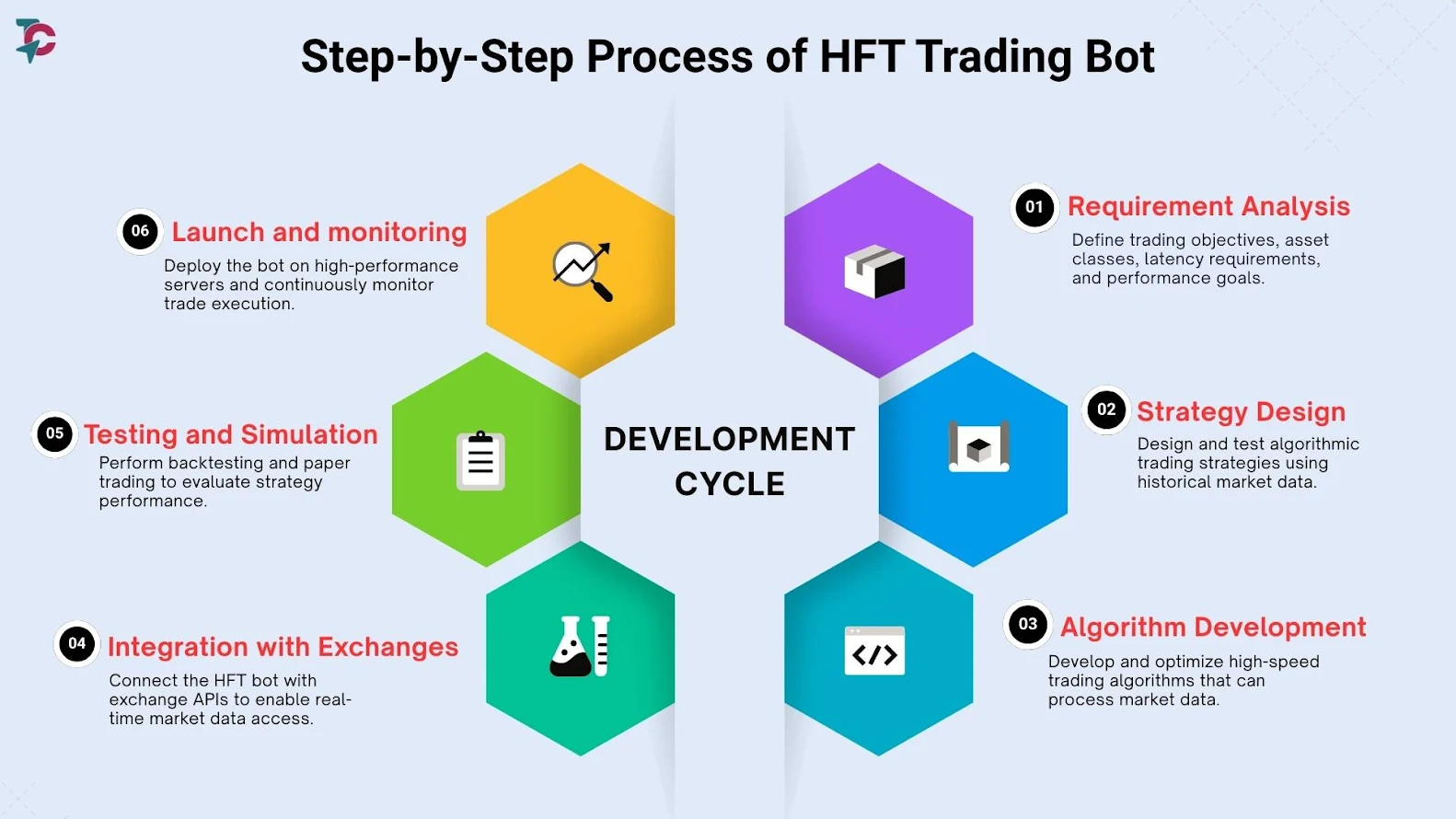
Requirement Analysis
The development begins by defining trading objectives, asset classes, and performance goals. This stage ensures alignment between business strategy and technical design.
Strategy Design
Trading strategies are mathematically modeled and tested using historical data. Only strategies with consistent performance metrics move forward. A user friendly dashboard increases user engagement and attracts a wider audience.
Algorithm Development
Core trading algorithms are coded and optimized for speed and efficiency. Special focus is given to minimizing computation and execution delays. Developers pay special attention to algorithm of the platform.
Integration with Exchanges
The bot is integrated with exchange APIs for real time data and order execution. Latency reduction is a major focus at this stage. It improves the speed, and efficiency of the platform.
Testing and Simulation
Complete backtesting and paper trading are performed, to validate strategy performance. Stress testing ensures system credibility during volatile markets.
Launch and Monitoring
The bot is launched on high performance servers, with continuous monitoring. Ongoing optimization ensures consistent trading efficiency. And frequent upgrades keep the platform updated.
Benefits of HFT Bot Development
- High Speed Trade Execution: HFT bots execute trades faster than any human trader. It captures opportunities that exist for milliseconds.
- Improved Market Liquidity: Continuous buying and selling help improve liquidity and reduce bid ask spreads.
- Emotion Free Trading: Automated execution eliminates emotional decision making; ensuring strategy discipline.
- Scalability Across Markets: HFT bots can operate across multiple exchanges, and asset classes simultaneously.
- Consistent Profit Opportunities: Small profits per trade turn into significant returns over high volumes.
- Operational Efficiency: Automation reduces manual effort and operational costs for trading firms.
Revenue Streams from HFT Bots
- Proprietary Trading Profits: Firms earn revenue directly from high volume and low margin trades.
- Arbitrage Opportunities: Profits are produced by exploiting price differences across exchanges.
- Market Making Income: Continuous buy and sell orders earn spreads, and exchange incentives.
- Subscription Based Platforms: Offering HFT tools or dashboards, to institutional clients generates a regular income.
- Licensing Trading Algorithms: Proprietary algorithms can be licensed, to other trading firms.
- Performance Based Fees: Revenue is earned based on profit sharing, or performance metrics.
Key Technologies Behind HFT Bots
Several advanced technologies power modern HFT bots and enable them to perform high-speed trading operations.
| Technology | Description |
|---|---|
| Advanced Algorithms | Well developed algorithms analyze market data, and identify profitable trading signals. |
| AI and Machine Learning | AI helps improve trading strategies; by analyzing historical data and predicting market behavior. |
| Cloud Infrastructure | Cloud based systems provide the computing power needed to process large amounts of market data in real time. |
| High Speed APIs | Exchange APIs allow bots to connect directly with trading platforms, for instant data access and order execution. |
Final Thoughts
HFT bot development represents the peak of speed driven algorithmic trading. It requires a deep understanding of financial markets, low latency engineering and robust risk management. When built correctly, HFT bots can generate consistent profits; while improving overall market efficiency.
However, success in HFT Trading Bot is not just about speed, it is about precision, security, and continuous optimization. With the right strategy, infrastructure, and technology stack, HFT bots can become powerful assets for modern trading businesses.