» Why Businesses Need Custom Supply Chain Management Software Development in 2026
In this evolving landscape, Supply Chain Management Software development has become a significant factor, in digital transformation for enterprises. It helps organizations unify processes, improve visibility and build smarter logistics ecosystems.
This blog explains how modern businesses can overcome supply chain challenges using custom digital solutions and why 2026 is a turning point for intelligent automation.
What is Supply Chain Software Development?
Supply Chain Software Development involves designing and building information technology systems which enable companies to handle the movement of goods and services in its entire cycle. It starts from the acquisition of raw materials, until the delivery to the final customer.
Today, in most companies, Supply Chain Management Software takes the central position; which coordinates supply chain elements such as purchasing, warehousing, logistics and customer fulfillment.
Such systems are often combined with ERP software solutions systems, inventory systems, logistics systems, and automation systems, to provide businesses with end to end visibility and control of their supply chain.
Why Traditional Supply Chain Systems are Failing
Traditional supply chain systems are struggling to keep up, with modern business complexity. Most legacy systems were designed for linear supply chains and lack flexibility for today’s dynamic environments.
Lack of real time tracking reduces visibility across operations. Manual data entry increases errors, and slows down workflows. Poor integration between systems creates data silos, that disrupt decision making. Delayed analytics and outdated infrastructure, further reduce efficiency.
Because of these challenges, businesses are rapidly adopting digital transformation solutions, enterprise software development, legacy modernization, cloud applications, and AI development services to build more agile and intelligent supply chain ecosystems.
Why Businesses Need Custom SCM Solutions in 2026
Multi Channel Commerce
Modern businesses function across multiple sales channels. Custom SCM systems unify these channels, into a single, streamlined workflow. They help coordinate inventory, orders and fulfillment across online, and offline platforms.
High Demand for Automation
Automated operations reduce manual activities, increase speed and cut down human error throughout the supply chain, automated process workflows increase business productivity, and business operating cost can be decreased.
Need for Real Time Analytics and Tracking
Companies need a view of inventory, shipment, and logistics performance to enable real time decision making. Real time tracking allows supply chain visibility and efficiency in operations. Advanced analysis aids in anticipating bottlenecks and optimizing the logistics performance.
AI Powered Decision Making Systems
AI enables predictive insights, demand forecasting and smarter logistics optimization across the supply chain. Businesses can make data driven decisions to reduce delays, and improve efficiency. AI powered tools also enhance resource planning and customer demand management.
Higher Customer Expectations
Customers want faster, more transparent and reliable delivery, and therefore optimized supply chains are vital. Companies will have to improve logistics functions, to keep up with escalating delivery demands.
Custom systems that are developed through Supply Chain Management Software allow an organization to be flexible, resilient and be integrated with other ecosystem.
Top Benefits of Custom Supply Chain Software Development
End to End Visibility
A custom system offers complete visibility from sourcing all the way to final delivery. This increases accuracy and control over operations and allows companies to track inventory and shipping status in real time.
Faster Decision Making
Real time dashboards and analytics allow businesses to react faster to disruption and workflow efficiencies. The live data assists organizations in acting more rapidly on market shifts and operational obstacles.
Lower Operational Costs
Automation will decrease human input, it reduces the error rate, and operational costs are minimized. An efficient process stream will enable firms to diminish expenditures, and waste resources.
Better Demand Forecasting Accuracy
AI powered analytics help businesses predict demand patterns more effectively and reduce stock issues. Accurate forecasting prevents overstocking, and reduces inventory shortages.
Improved Supplier and Vendor Collaboration
Centralized systems improve communication, and coordination across all supply chain partners. Businesses can streamline procurement, order management and vendor interactions efficiently with CRM development services.
Increased Scalability
Custom systems are designed to grow with the business, supporting expansion without performance issues. Scalable SCM solutions help businesses expand into new markets with greater efficiency.
Working with SCM Software Development Services helps organizations build optimized and future ready supply chain ecosystems tailored to business needs.
Key Features Businesses Need in 2026
AI powered Demand Forecasting Systems: AI models analyze historical data to predict future demand accurately and reduce supply gaps. This helps businesses improve inventory planning and maintain optimal stock levels.
Real Time Shipment Tracking: Companies can instantly track their deliveries, and receive notifications in the event of a delay or problem. Real time tracking enhances delivery control, and allows better customer interaction.
Blockchain Based Transparency: Blockchain development services offers tamper-proof, secure and transparent supply chain data. The network of supply chain can be trusted, tracked and accounted.
IoT Enabled Logistics Monitoring: IoT devices can monitor real time tracking of assets, vehicles and inventory. The benefit of real time tracking is more operational efficiency and can support predictive maintenance and fast tracing.
Cloud Based Centralized Dashboards: Cloud platforms provide unified access to supply chain data from anywhere. They improve collaboration, data accessibility and real time decision making capabilities.
Predictive Analytics: Accurate forecasting can ensure that businesses neither overstock, nor stock out. They can efficiently manage their stock levels, and optimize their supply chain proactively.
All of the capabilities mentioned are enabled through artificial intelligence, machine learning, big data analytics and cloud computing. Through the development of contemporary Supply Chain Management Software solutions, businesses are able to develop flexible systems capable of adapting to changing market dynamics.
Industries Using Supply Chain Software
- Healthcare: Ensures timely delivery of essential medical equipment, and reduces shortages. It also improves inventory tracking and supports efficient healthcare supply chain management.
- E commerce: Improves order processing speed, and enhances customer delivery experience. Centralized SCM systems also help manage inventory, and fulfillment across multiple sales channels.
- Manufacturing: Reduces waste of raw material and optimizes production plan. Manufacturers can improve efficiency and increase productivity by using it.
- Retail for demand planning: Helps maintain optimal inventory levels across multiple locations. Accurate demand forecasting also reduces stock shortages and overstocking issues.
- Food delivery services: Accelerates the delivery process and cuts down on transport delays. Real time tracking and route optimization boosts both customer satisfaction and the business itself.
- Logistics and fleet management: Enhances route planning, fuel efficiency, and fleet monitoring. Advanced tracking systems also improve delivery performance and reduce operational costs.
Organizations using SCM Software Development Services benefit from better accuracy, reduced delays, and improved operational control across all industries.
Why Custom Software is Better than Ready Made Solutions
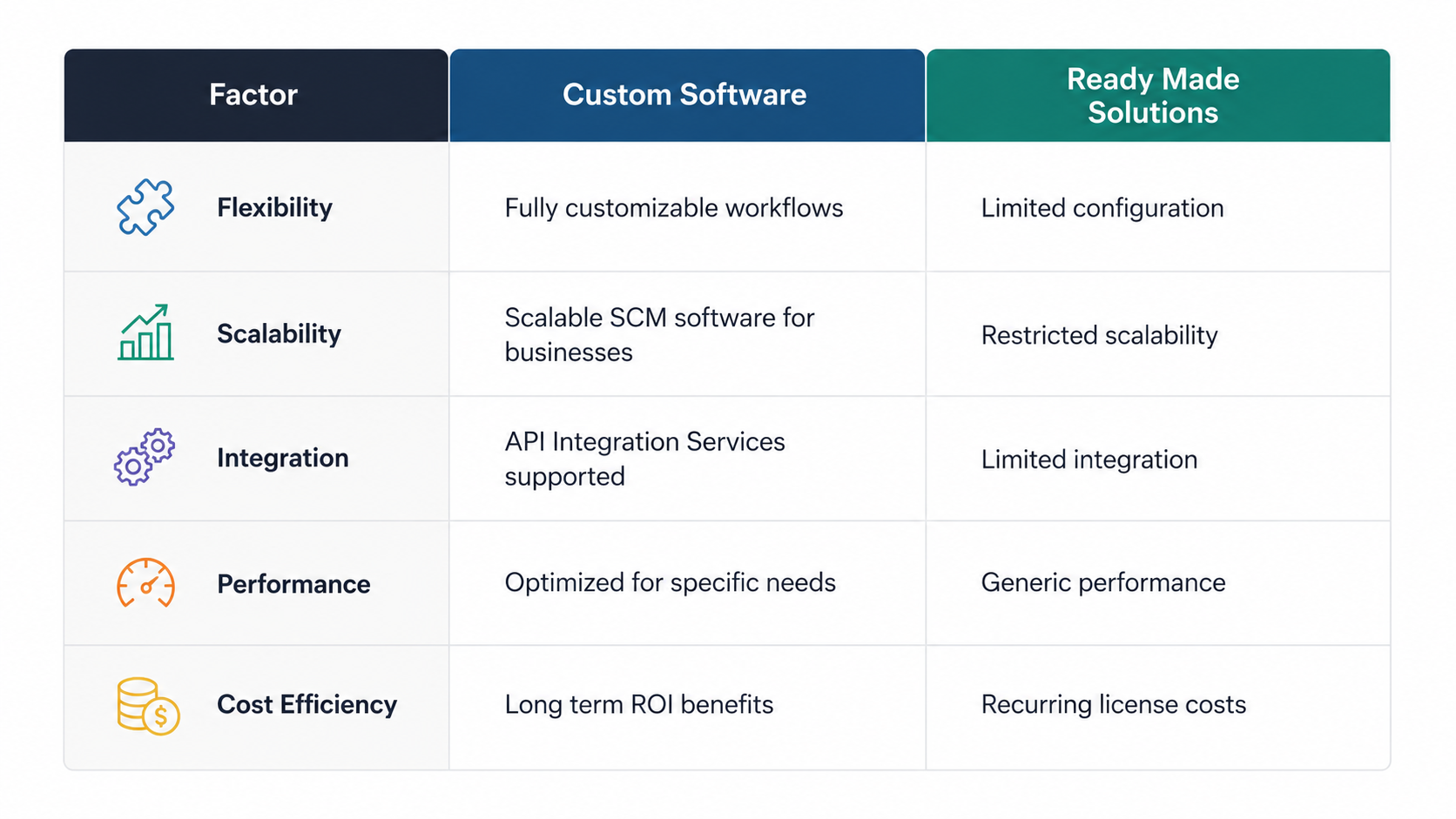
Custom systems such as Custom ERP Development offer better control, scalability, and integration with enterprise ecosystems. They also support Enterprise Mobility Solutions, API Integration Services, Scalable Software Solutions, and Software Consulting Services.
Future Trends in Supply Chain Software Development
AI Automation Solutions: AI systems automate operations and improve forecasting accuracy. They also help businesses reduce manual effort and optimize supply chain workflows efficiently.
Blockchain Supply Chain Solutions: Provides security, traceable and non-tamper logistic networks. Blockchain technology adds visibility and confidence in all aspects of supply chain.
Smart Contract Development: Automates agreements and reduces dependency on intermediaries. It speeds up transaction processes and minimizes operational disputes effectively.
Machine Learning Development: Enhances accuracy of forecasting and operational planning. Machine learning models also allow for trend identification and the optimization of logistic performances.
Big Data Analytics: Allows companies to instantly make data based decisions. Sophisticated analytical solutions enhances supply chain transparency and operational efficiency.
Cloud Based ERP systems: Offers manageable, cost effective and central management of the enterprise. Further enhance co-ordination and instant access of data for various team.
These advancements will bring the development of Supply Chain Management Software into automated and smart entities.
Conclusion
Supply Chain Management Software development is now a strategic necessity, rather than a technical upgrade. It enables real time visibility, improved forecasting and optimized end to end operations.
With Supply chains growing in complexity, Supply Chain Management Software, that will make companies more robust, and competitive. Key factor that helps to facilitate digital transformation and operational efficiency.
To stay ahead in 2026, companies must invest in automation, AI driven insights and SCM Software Development Services. Partnering with experts like Touchcrypto, helps businesses build scalable, intelligent and future ready supply chain solutions that deliver measurable impact.
Frequently Asked Questions in SCM
What is SCM software Development?
It is the process of creating digital systems, that manage and optimize the entire supply chain process from procurement to delivery. It improves efficiency, visibility and control.
Why do businesses need supply chain automation?
Automation removes manual processes; which leads to fewer errors and faster operations. The business can achieve efficient supply chain management faster, with greater accuracy.
What are the features of SCM software?
Key features of SCM software include real time tracking, AI forecasting, analytics dashboards, automation tools and cloud based access for better visibility.
How does AI improve Supply Chain Management?
AI aids in estimating delays and predicting demand. And it streamlines the supply chain and inventory to ensure greater efficiency.
Which industries utilize SCM software?
SCM systems have found wide applications in Industries such as retail, manufacturing, healthcare, logistics, e-commerce, and food delivery to enhance efficiency of the performance.